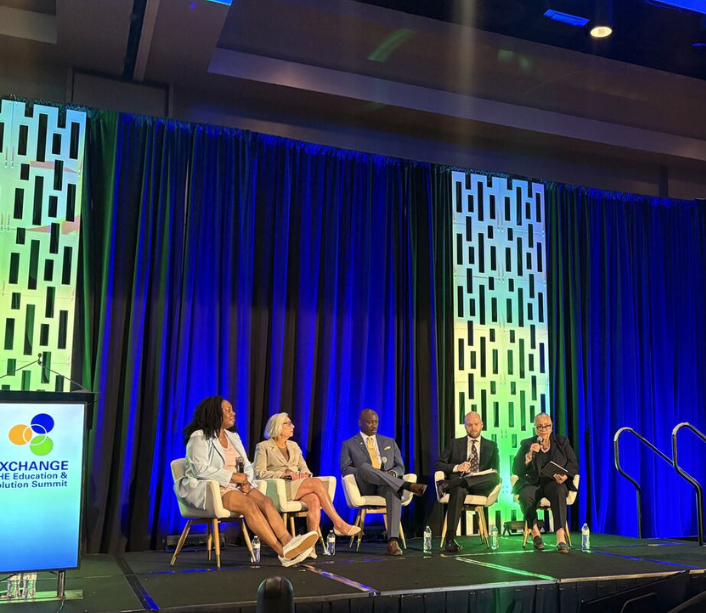
At the recent Association for the Health Care Environment (AHE) Exchange26 Summit in New Orleans, a major General Session titled “UV Devices in the Healthcare Environment: Considerations EVS Professionals Should Know” was a central feature of the Technology & Innovation track.
As healthcare facilities increasingly evaluate UV and other adjunctive technologies to supplement environmental cleaning and disinfection, understanding the regulatory landscape has become essential. During the AHE session, experts representing regulatory, clinical and healthcare perspectives examined what FDA oversight means for manufacturers, healthcare providers and the professionals responsible for evaluating these technologies. The discussion offered important clarity around Whole Room Microbial Reduction, the evidence required for FDA authorization and the risks associated with unauthorized or off-label claims.
- Whole Room Microbial Reduction is an FDA-regulated medical device category.
During the panel discussion, Christopher Dugard, Director of the FDA’s Division of Infection Control Devices within the Office of Surgical and Infection Control Devices, clarified that Whole Room Microbial Reduction is a distinct Class II medical-device category established by the agency in 2023. When a device using UV or chemical-based technology is intended to reduce microbial load on medical-device surfaces following cleaning and disinfection, it is subject to FDA requirements. Claims that a device reduces or prevents infections, including healthcare-associated infections, also cross into medical-device territory and require appropriate clinical evidence.
Importantly, the discussion reinforced that EPA registration or oversight does not replace FDA authorization when a product is intended and marketed for these medical-device uses. For healthcare organizations evaluating UV technologies, the relevant question is not simply whether a device has an EPA registration, but whether it is FDA authorized for the way the facility intends to use it.
Our takeaway: if your device is intended to achieve microbial reduction on another medical device or surface, your device defaults to being regulated by the FDA.
- FDA authorization represents a substantive review, not simply a marketing label.
Also discussed during the session was that the FDA authorization process requires rigorous performance testing by device manufacturers to demonstrate microbial reduction performance, device safety, labeling, intended use and applicable special controls. For the 510(k) pathway, manufacturers must demonstrate that their device is at least as safe and effective as the predicate device. This was referenced by the agency as meeting substantial equivalence.
The session also clarified that the 2-log reduction demonstrated by authorized devices to date is not an arbitrary marketing benchmark. It was established through the FDA’s Whole Room Microbial Reduction category and the predicate device. In worst-case conditions testing reviewed by the FDA, these devices consistently achieved at least a 2-log microbial reduction throughout the treated room, including against C. difficile spores. This represents the minimum demonstrated performance under challenging conditions, not the maximum reduction the devices may achieve.
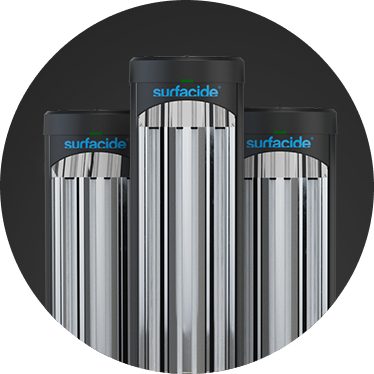
In fact, in its validated cycles and as part of its optimized kill curve testing completed for FDA pre-market review, Surfacide Helios+ delivers a dosage of up to 1,300 mJ/cm2 or 1.3 J/cm2 to multi drug resistant organisms with increased resiliency like C difficile in order to achieve Whole Room Microbial Reduction.
Panelists further emphasized that Whole Room Microbial Reduction is intended to supplement, not replace, manual cleaning and disinfection. Together, these requirements provide healthcare organizations with a consistent, evidence-based framework for comparing technologies that may appear similar in a sales presentation but have not undergone the same regulatory review.
- Unauthorized and off-label claims create significant risk.
Former FDA regulator Liz Claverie emphasized during the session that labeling or marketing a product as a medical device without the required FDA authorization may constitute misbranding under federal law. She also warned that promoting or using a device for purposes outside its authorized labeling can expose both the manufacturer and the healthcare provider to serious consequences:
“Using a medical device off-label creates a major legal and regulatory risk for the healthcare provider. So, it’s not just you. Now you’re placing the healthcare provider at risk, and there’s heightened liability for medical malpractice, regulatory penalties from agencies like my former agency, the FDA, state medical boards, loss of institutional accreditation, etc.”
Claverie also noted that risk can arise even when a device carries appropriate labeling if a salesperson verbally promotes it for an unauthorized use. As she stressed during the session, off-label promotion is not simply a marketing concern. It can place the healthcare organization relying on those claims at significant legal, regulatory and institutional risk.
Chris Dugard explained the broader value of regulation: it creates accountability and provides greater assurance that manufacturers’ claims are truthful and supported by evidence. Without that oversight, companies could simply make increasingly impressive-sounding claims, leaving healthcare organizations without a reliable basis for evaluating or comparing technologies.
Overall, the session reinforced that FDA authorization is required for any device claiming whole room microbial reduction, and FDA clearance is far more than a regulatory milestone. It gives healthcare organizations greater confidence that a device’s intended use, performance and safety claims have undergone substantive review. For healthcare leaders evaluating Whole Room Microbial Reduction technologies, due diligence should begin with confirming FDA authorization and continue with ensuring that every written and verbal claim aligns with the device’s authorized labeling. In a regulated category, those distinctions matter for informed purchasing decisions, patient safety, organizational accountability and institutional risk.
Kudos to AHE for bringing this timely educational session to Exchange26 and helping provide greater clarity around an important and often misunderstood topic.